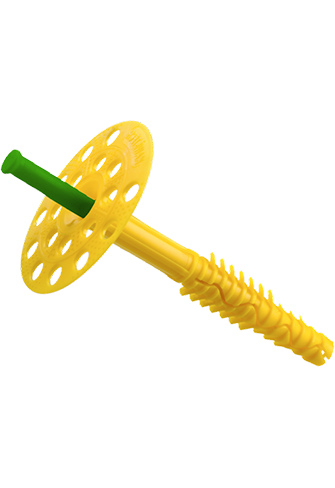
THERMOMAX® DBL 60P
THERMOMAX® DBL 60P is a plastic nail anchor with a wide plate, used for the mechanical fixing of thermal insulation boards. Its 60 mm plate distributes the load over a large area of the board surface and secures the system against wind suction loads.
It is a component of external thermal insulation composite systems (ETICS).
Fields of Application
• Mechanical fixing of insulation boards in external thermal insulation composite systems (ETICS)
• Fixing of EPS and XPS boards
• On concrete, solid brick, aerated concrete and lightweight concrete substrates
Advantages
• The plastic nail gives a much lower point thermal transmittance than a metal nail; no cold spots or marks appear on the façade
• Being fully plastic, it does not corrode; no rust stains appear on the façade
• The wide 60 mm plate spreads the load over a large area of the board and prevents it from sinking into the board
• Suitable for concrete, brick, aerated concrete and lightweight concrete substrates
• Resistant to corrosion and mechanical stress
|
General Information |
|
|
Product type |
Wide-plate plastic nail anchor |
|
Sleeve material |
Polypropylene (PP) |
|
Nail material |
Glass-fibre-reinforced polypropylene |
|
Plate diameter |
60 mm |
|
Sleeve diameter |
10 mm |
|
Performance Data |
|
|
Use categories (EAD 330196) |
A – Concrete B – Solid brick / solid masonry D – Lightweight concrete E – Aerated concrete |
|
Point thermal transmittance (χ) |
≤ 0.002 W/K |
|
Service temperature |
−40°C / +80°C |
|
Corrosion resistance |
Fully plastic; does not rust |
|
Application Data |
|
|
Drill diameter |
10 mm |
|
Min. hole depth |
Anchor length + 10 mm |
|
Anchorage depth (embedment in substrate) |
Min. 50 mm (in solid substrates) |
|
Drilling method |
Hammer drilling in concrete and solid brick Rotary only in aerated and lightweight concrete |
|
Number of anchors |
Field of façade: min. 6 pcs/m² Edge zones: min. 8 pcs/m² (according to wind load calculation) |
|
Waiting time after bonding |
Minimum 24 hours |
|
Application temperature |
Above 0°C |
|
Safety and Certification |
|
|
Reaction to fire class (EN 13501-1) |
Class E |
The technical values stated were obtained at an ambient temperature of +23°C and 50% relative humidity.