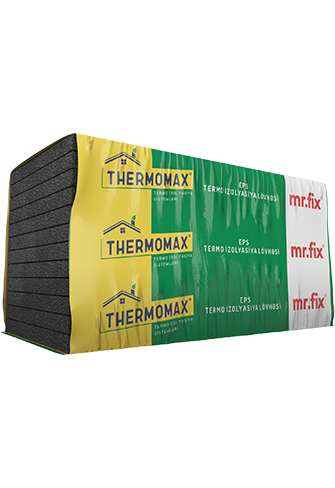
THERMOMAX® EPS CARBON
THERMOMAX® EPS CARBON is a graphite-enhanced expanded polystyrene insulation board used for thermal insulation on vertical and horizontal surfaces of buildings. The graphite in its structure reflects thermal radiation and delivers a thermal conductivity roughly 20% lower than white EPS of the same density, so the same insulation performance is achieved with a thinner board.
It complies with EN 13163 and is produced in three compressive strength classes: EPS 50, EPS 90 and EPS 120.
Fields of Application
• External thermal insulation composite systems (ETICS)
• Façade applications where board thickness is restricted
• Internal wall insulation
• Loft spaces, roof compartments and non-trafficked roofs
• Thermal insulation of floors, under screed and ceilings
Application Area – Type Selection
The table below shows the suitable THERMOMAX® EPS CARBON type for each application area together with the property governing the selection. The final type and thickness must be determined according to the thermal calculation and load values of the specific project.
|
Application area |
EPS 50 |
EPS 90 |
EPS 120 |
Governing property |
|
External wall insulation (ETICS) |
● |
● |
● |
Tensile strength perpendicular to faces EN 1607 ≥ 100 kPa (TR100) |
|
Façade applications with restricted thickness (recesses, balconies, boundary lines) |
● |
● |
● |
Thermal conductivity (λD) |
|
Internal wall insulation |
● |
● |
○ |
Thermal conductivity (λD) and water vapour diffusion |
|
Non-trafficked roof, loft space, warm roof |
● |
● |
○ |
Thermal conductivity (λD) |
|
Basement / garage ceiling insulation |
● |
● |
○ |
Thermal conductivity (λD) |
|
Floor insulation under screed (residential, foot traffic) |
○ |
● |
● |
Compressive stress CS(10) |
|
Trafficked terrace roof (under screed) |
– |
○ |
● |
Compressive stress and long-term deformation (EN 1606) |
|
Industrial floor, under vehicle load |
– |
– |
○ |
Compressive stress CS(10) |
|
Cold storage room |
– |
– |
○ |
Water absorption and compressive stress |
|
Foundation / external wall below grade, soil contact |
– |
– |
○ |
Water absorption |
• Recommended ○ May be used depending on the project – Not recommended
• Graphite-enhanced boards absorb a high proportion of incident sunlight. Boards left in direct sun may show heat-related dimensional change, bowing and opening of joints. A shading net must be used on the façade and, on sun-exposed elevations, installation should be moved to the morning and evening hours.
• In external thermal insulation composite systems the governing property is not compressive stress but tensile strength perpendicular to the faces (EN 1607).
• Under permanent load, to keep deformation within 2% over a 50-year service life, the permanent load should not exceed approximately 30% of the CS(10) value (EN 1606).
• For industrial floors and cold storage rooms requiring higher compressive strength, THERMOMAX® EPS 200 should be preferred.
Advantages
• The graphite content reflects thermal radiation, giving a thermal conductivity roughly 20% lower than white EPS of the same density
• The same U-value is achieved with a thinner board, saving thickness on the façade
• Lightweight; adds no significant load to the structure
• High dimensional stability; retains its shape
• Easy to cut and install, saving labour
• Water vapour permeable; reduces the risk of condensation when used in adequate thickness
• Does not rot or grow mould; retains its physical properties over a long period
|
Property |
Unit |
EPS 50 |
EPS 90 |
EPS 120 |
|
General Information |
||||
|
Material composition |
– |
Graphite-enhanced expanded polystyrene (EPS) |
||
|
Appearance |
– |
Grey, cut board |
||
|
Average density (approx.) |
kg/m³ |
15 |
18 |
21 |
|
Board size |
cm |
50 × 100 |
||
|
Board thickness |
cm |
5 – 6 – 8 – 10 |
||
|
Thermal Properties |
||||
|
Thermal conductivity (λD – EN 12667) |
W/mK |
0.033 |
0.032 |
0.031 |
|
Service temperature |
°C |
−50°C / +75°C |
||
|
Mechanical Properties |
||||
|
Compressive stress at 10% deformation (EN 826) |
kPa |
≥ 50 CS(10)50 |
≥ 90 CS(10)90 |
≥ 120 CS(10)120 |
|
Tensile strength perpendicular to faces (EN 1607) |
kPa |
≥ 100 TR100 |
≥ 100 TR100 |
≥ 150 TR150 |
|
Bending strength (EN 12089) |
kPa |
≥ 100 BS100 |
≥ 135 BS135 |
≥ 170 BS170 |
|
Dimensional Tolerances and Stability |
||||
|
Length tolerance (EN 822) |
mm |
± 2 (L2) |
||
|
Width tolerance (EN 822) |
mm |
± 2 (W2) |
||
|
Thickness tolerance (EN 823) |
mm |
± 1 (T2) |
||
|
Squareness tolerance (EN 824) |
mm/m |
± 2 (S2) |
||
|
Flatness tolerance (EN 825) |
mm |
5 (P4) |
||
|
Dimensional stability, 23°C / 50% RH (EN 1603) |
% |
± 0.2 — DS(N)2 |
||
|
Dimensional stability, 48 hours / 70°C (EN 1604) |
% |
≤ 1 — DS(70,-)1 |
||
|
Water and Water Vapour Properties |
||||
|
Long-term water absorption by immersion (EN 12087) |
vol. % |
≤ 5.0 WL(T)5 |
≤ 3.0 WL(T)3 |
≤ 3.0 WL(T)3 |
|
Water vapour diffusion resistance factor (EN 12086) |
μ |
20 – 40 |
30 – 70 |
30 – 70 |
|
Safety Information |
||||
|
Reaction to fire class (EN 13501-1) |
– |
Class E |
||
|
Hazardous substances |
– |
Refer to SDS |
||
The technical values stated were obtained at an ambient temperature of +23°C and 50% relative humidity.